



新闻中心
Application Scope and Usage Categories of Horizontal Screw Decanter Centrifuges
The horizontal screw decanter centrifuge is a manually operated, intermittent feeding centrifuge. According to separation principles, it can be categorized into two types: the horizontal screw decanter centrifuge filter (SS type) and the horizontal screw decanter centrifuge sedimentation (SSC type).
This equipment is suitable for separating mixed liquids containing solid particles ≥0.01 mm in size. The solid phase may exist in granular, crystalline, or fibrous forms, or for dewatering of continuous materials (e.g., yarn bundles, textile products). Its advantages include a simple structure, easy operation, adjustable process steps as required, thorough sediment washing, minimal damage to solid particles, and strong adaptability. For non-homogeneous separation scenarios involving fine sticky materials or difficult-to-recover filtered products, except for less pronounced cleaning functions, it shares the advantages of the filtration type.
Both types of centrifuges are widely used in chemical industry, light industry, pharmaceuticals, food processing, textiles, metallurgy, and machinery sectors.
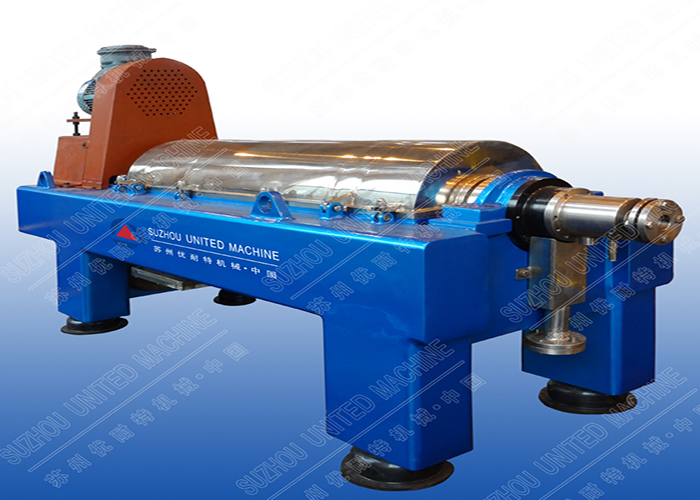
The machine operates normally under the following conditions: working temperature 0-40°C, relative humidity not exceeding 85%, and altitude not exceeding 1000m. The motor power supply voltage is 380V with a working frequency of 50Hz.
Unless otherwise specified, all parts in contact with materials are manufactured from low alloy steel 1Gr18Ni9Ti (SUS304). It should be emphasized that stainless steel is not resistant to all material corrosion. Therefore, corresponding stainless steel grades (SUS304, 316, 316L, 321, etc.) or titanium (TA) may be selected based on the corrosion resistance requirements of the materials to be separated. Surface linings in contact with materials include rubber lining, PE lining, and HALAR lining.
The machine structure is not explosion-proof. Without special measures, flammable/explosive materials shall not be processed. If the customer installs an explosion-proof motor to process flammable/explosive materials, the safety responsibility lies with the customer. However, the following precautions are recommended:
1. Enhance ventilation at the working site to dilute the concentration of explosive gases.
2. Preferably use anti-static V-belt drive systems.
3. Metal shovels shall not be used during discharging.
4. Regularly inspect the wear of friction plates in clutch and brake systems. If friction plates are found rubbing against stainless steel components, they shall be replaced immediately